The Butcher, The Baker & The Music App Maker…
It’s fair to say that the point in history we’re currently in is strange. Exciting. Sometimes concerning. Full of disagreement and yet undeniably holding the most enormous potential.
You can’t help but wonder if the AI revolution is a bit like an enchanted looking glass: people tend to see what’s loitering inside them and extrapolate that outwards.
From our point of view
AI is going to significantly reshape the audio we hear; but it’s not going to be through generative audio (or not that much anyway).
It’s going to be through the software instruments and tools that it builds for us to use…
Writing music software has been something we have wanted to do for a very long time, for well over a decade now.
With a background in web development through Sample Genie but outside that too, mostly in environments of PHP, databases, APIs, JavaScript and server-side application logic. We achieved things we are really proud of, especially in the formative days of Sample Genie where the proprietary tech didn’t exist yet. Membership sites were not commonplace, like they are now, and we had to create a lot of bespoke APIs and file delivery tools, which back then was quite a big deal.
Behind the scenes – as well as the web developing knowledge – some of us had music signed and played by the biggest names in the industry, another with proficient engineering skills, even able to write the maths around Wi-Fi transmission; and yet, writing compelling audio plugins was proving much harder than expected… The furthest we really got was some UIs and hand-coding an oscillator, filter, gain stage and some basic envelopes using C. The trail ran a bit cold in terms of designing exciting new instruments, and we soon focused on other things…
Fast forward to recent years: We found we had been using AI increasingly for speeding up dev tasks, fixing bugs and other routine jobs. And then we began to wonder… ‘could we bridge the gaps in our knowledge surrounding plugin design and using C++ by using these AI tools?’
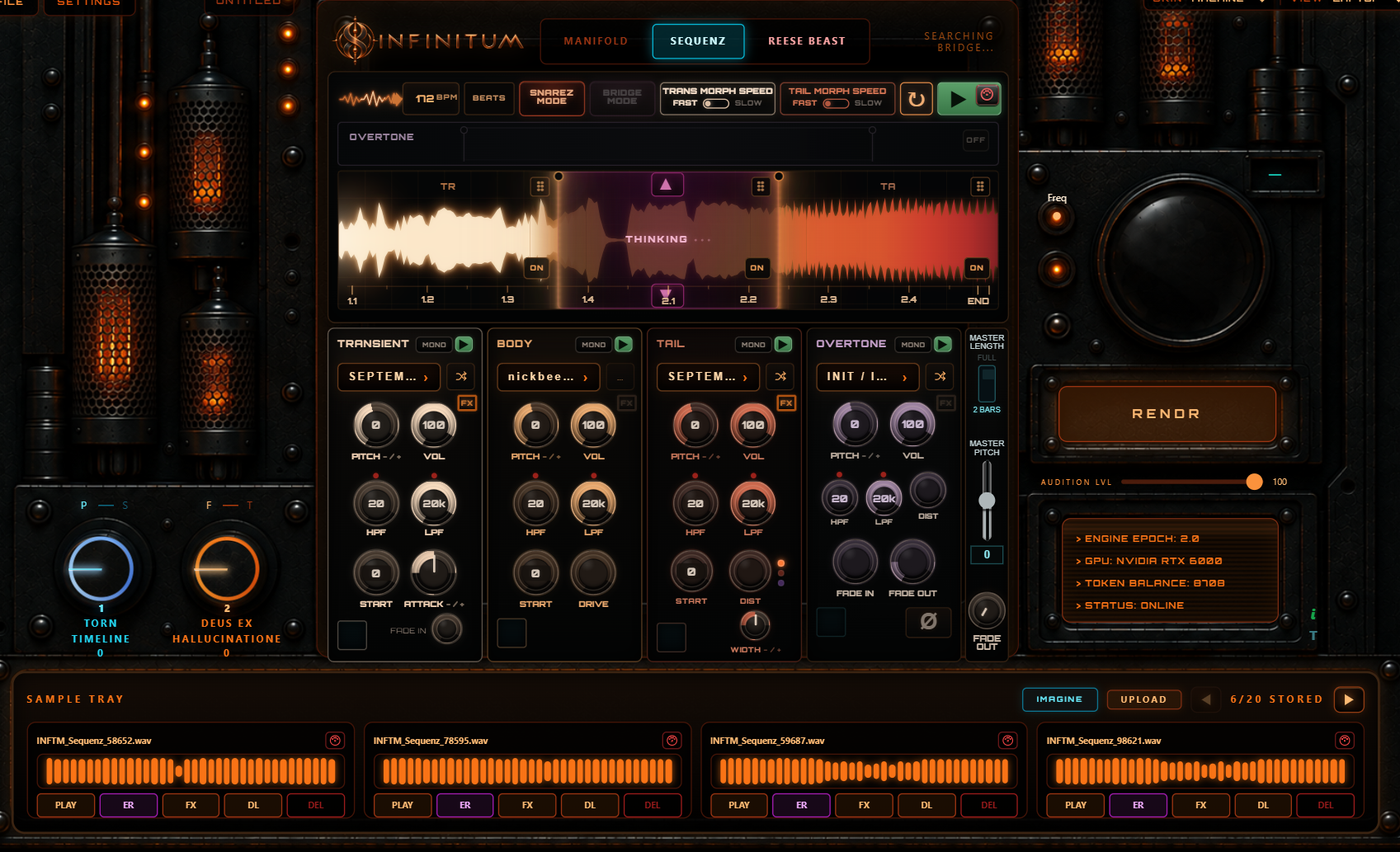
Early on, it was slow going, they were clumsy under-thinkers, but in the last year they have risen to a completely different level. We were able to complete our new platform and INFINITUM was built. It still took nearly a year of 8-18hr days but the AI codebase made the implimentation possible. Although, we must say a big thank you to the remarkable Paul Visser for his expert advice and code offerings for performance audio C implimentation in the desktop version – a reminder of what kind of knowledge these neural tools were built on.
OK, to be fair, we probably launched the web version a bit too soon, it wasn’t quite ready. But still, that prototype and feedback process all shaped the desktop application and VST that we have today, by listening and building in the features people wanted.
So here’s the heads up: What you are about to see is a towering tidal wave of plugins coming at you. Don’t be alarmed if your barber tells you about their new sound design app. It will come in all shapes and sizes. Some of it original, some of it drab; but prepare yourself – there is about to be a glorious bandwagon of plugins careering towards you: and at speed!
AI removes some of the historical barriers between having an audio-processing idea and being able to implement it.
Audio plugin development has traditionally favoured a certain kind of person: usually someone with a background in mathematics, C++, DSP theory and highly structured engineering. Logical, typical left hemispheriacs. Make no mistake, that format of person has produced some incredible music technology, but it has also meant that many of the people closest to the creative problem — producers, sound designers and experimental musicians — have depended on somebody else to build their ideas.
That boundary is now basically gone.
A producer, DJ, raver, can now describe a processing concept, explore the mathematics behind it, generate prototypes, debug algorithms, translate Python DSP into C++, build UI systems, understand compiler errors and iterate on architectures with AI acting as a technical collaborator.
The downside as a maker of sofware is that it will increasingly be harder to make a business out of it, as the market saturates to unimaginable levels sofware will move to a different place. Wall Street has already dubbed this the SAASpocalypse (software as a service). But as a creative it means there will be such an array of tools available, and at very little or no cost. We will move beyond the current situation where everyone has exactly the same tools. And also hardware, there is a big resurgence in interesting hardware devices and sound generation tools fascinating things like this. AI will assist thinkers and makers’ design circuits, design schematics and bring such things to life.
Across the coming decade this is going to have a profound effect on electronic music.
Some of the most interesting developments in sound have historically come from people misusing technology, connecting things that were never meant to be connected, or approaching engineering problems from a musical rather than purely mathematical perspective.
Once those people can build their own processors, instruments and analysis systems, we are likely to see far stranger tools emerge.
Not simply another compressor, synthesiser or reverb, but software based on perceptual relationships, spectral structures. Neural representations and transformations that would previously have required a small research team to prototype are built in weeks.
The next revolution in music technology is not AI generating music; It’s AI allowing musicians to invent the technology that generates entirely new kinds of sound.
But we feel it makes sense to embrace it rather than hide it or pretend it’s not so. Perhaps some of the people most critical of AI, SUNO etc, have now found themselves building new tools using it, it puts them in an odd spot, and thus sadly and having to keep things quieter.
For example – you may have noticed this influx of software is already happening? And perhaps you have noticed the way in which the (many awesome) plugins are marketed and shown off seems to follow a similar format? Not a high-res, screen capture footage of the plugin or animation. The format seems to be a smart phone recording of a finger pointing at a computer screen “you are not gonna believe this plugin” or something along those lines. Quite clearly, we can see these plugins are made with (or by) AI tools, but perhaps the human hand pointing at the screen serves as the green flag of humanised safety, some gentle misdirection?
The honest question to ask here now is – what’s the point? Why don’t we accept and welcome in this new era and celebrate what this technology allows us to achieve. Your idea, your final design and plugin is no less interesting, useful or impressive, and you are the one who conjured it into existence.
With this being said (and with full awareness of the tidal wave that is about to hit you) we are going to take a slightly quieter route from here to save your bandwidth.
Our platform is built now. It’s done. It’s taken a few years of planning and the better part of a year to build, but it’s ready. We will post about version and feature updates from time to time, but in regular hours: you know where to find it. We’ll talk directly with you about it over email and can’t wait to show you some of the new features that are coming soon!
It’s exclusively available under license only for premium members of the site, at no additional cost.
INFINITM Desktop Edition is out 10th October for PC and 24th October for MAC.